
Humans of Maynooth Episode 3: Empowering Women in Tech with Archana Sahoo from India
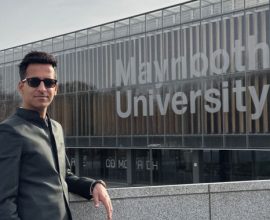
In the last episode of our Humans of Maynooth series, we explored the journey of Sichen Huangfu, a PhD in Education, who shared her courageous path in overcoming homesickness to pursue qualified research projects in Ireland. In this third episode, we shift our focus to another inspiring voice in the Maynooth University community — Archana Sahoo from India. Currently, she is a postgraduate student in Software Engineering.
With a background in the IT industry and a passion for both theoretical knowledge and hands-on development, Archana opens up about returning to academia, navigating the challenges of a rigorous MSc program, and finding empowerment through the Women in STEM community at Maynooth University. Her story is a testament to resilience, personal growth, and the importance of representation in tech.
—
Eunice: Hi Archana, welcome to the Humans of Maynooth series! Although I’ve briefly heard about you through Chang, your classmate, could you please introduce yourself and tell us a bit about your current postgraduate program or field of study?
Archana: I’m Archana Sahoo. Before starting this MSc in Software Engineering (Computer Science) at Maynooth University, I spent just over three years working as a Software Engineer in the IT industry. My decision to return to academia was driven by a desire to deepen my understanding of the theoretical foundations behind the systems I’d been building and to pick up more rigorous, up-to-date practices something Maynooth’s program offered in spades.
Right now, my postgraduate year is split across two semesters (plus a year‐long project), and the modules cover everything from requirements gathering and system design to practical cryptography and interaction design. In Semester 1, I’ve tackled:
- Requirements Engineering & System Design (CS607): learning how to map stakeholder needs into scalable architectures
- Advanced Concepts in Object‐Oriented Programming (CS613): digging deeper into SOLID principles and design patterns
- Practical Cryptography (CS616): understanding encryption algorithms, hashing, and secure key management
- Databases (CS621B): covering everything from relational schema design and normalization to basic NoSQL concepts
In Semester 2, I’m working through:
- Rigorous Software Process (CS603): comparing agile, waterfall, and hybrid models, and practicing proper documentation and version‐control workflows
- The Mathematics & Theory of Computer Science (CS605): focusing on automata, decidability, and complexity, which helps me appreciate why certain problems can’t be solved efficiently
- Software Testing (CS608): writing unit/integration tests, learning test-driven development, and exploring continuous‐integration practices Interaction Design
- (CS610): prototyping user interfaces with usability principles in mind
- Internet Solutions Engineering (CS615): building and deploying small‐scale web applications, which ties together everything from backend services to front‐end frameworks
All of this feeds directly into the Year‐Long Project (CS640), where I’m applying what I’ve learned to design, implement, and test a real‐world system from scratch.
My field of study revolves around understanding not just “how” to build software, but “why” certain architectures or processes work better in different contexts, everything from formal verification to hands‐on full‐stack development. Outside the classroom, I’m also active in Women in STEM, which keeps me connected to other students and professionals who share similar goals around diversity and leadership in tech. Altogether, the program is equipping me with both the hard skills (system design, cryptography, databases) and the soft skills (requirements analysis, teamwork, documentation) that I know will shape my future career.
Eunice: Wow, Archana. That sounds impressive and tough at the same time. You know, my background is in Social Science, and it’s different in comparison with your major. To me, what you’re sharing is a whole new world, and I’m wondering what initially sparked your interest in STEM, or specifically, Software Engineering at MU?
Archana: I’ve always been drawn to problem-solving and technology from my undergrad projects to three years working as a Software Engineer. When I researched postgraduate options, Maynooth University stood out for its strong Computer Science reputation and supportive community, especially through Women in STEM. Seeing opportunities to learn rigorous theory (like formal methods and cryptography) alongside practical skills (database design, full-stack development) convinced me that Maynooth was the right place to deepen my passion for software engineering.
Eunice: What a brave woman you are! You clearly know what you like, and you have a strong sense of your strengths and weaknesses. The way you speak is both logical and thoughtful, and I believe these qualities align perfectly with the path you’ve chosen.
From what I’ve heard from other students, I completely agree with you — Maynooth University offers highly qualified Computer Science-related programs. But with that quality also comes challenges, right? What has been the most challenging aspect of your postgraduate studies so far, and how have you managed to overcome it?
Archana: The hardest part so far has been juggling the depth of Theory of Computation (CS605) with my other modules’ practical demands especially when a big test was upcoming in computation theory landed the same week I had to deliver a full-stack mini-app for Internet Solutions Engineering (CS615) along with a CA in Dafny. Grasping concepts like decidability and complexity felt like learning a new language, and at the same time I couldn’t fall behind on coding deadlines or software-testing labs.
To get through this, I:
- Structured my time aggressively. I set aside dedicated “theory blocks” each week for an hour or two where I focused solely on working through automata questions or complexity exercises so those concepts didn’t bleed into my coding hours.
- Formed a small study group. Three of us met twice a week to walk through tricky proofs and explain them out loud. Teaching each other helped cement the material faster than going solo.
- Leveraged office hours early. As soon as I felt stuck on a proof or a test-coverage problem, I booked a quick chat with Prof. Naughton or Stephen Brown. Their clarifications saved me hours of frustration.
- Merged theory with practice where possible. Whenever I learned a formal result in computation, I tried to spot its influence in my Internet Solutions work like understanding why certain algorithms simply couldn’t run efficiently on large datasets so both subjects reinforced each other.
By front-loading theory study, asking for help early, and intentionally connecting abstract concepts to hands-on projects, I managed to navigate those overlapping deadlines without feeling overwhelmed.
Eunice: That’s really interesting! Apart from these challenges, what has been the most rewarding or surprising aspect of your journey so far — something that made all your hard work feel especially worthwhile?
Archana: The most rewarding part has been watching abstract concepts click into place when applied. For instance, after working through formal proofs in Theory of Computation, I used that same rigor to optimize database queries in my Internet Solutions project seeing response times drop by rethinking an algorithm was a real “aha” moment.
Another pleasant surprise has been how much my confidence grew through Women in STEM activities. Simply attending mentorship sessions and coding meet-ups taught me that I could not only learn from others but also contribute back whether by helping a peer debug a tricky test case or by co-organizing small discussion groups. Hearing positive feedback on my cryptography assignment demo and nailing a complex system-design sketch in Requirements Engineering showed me how far I’d come. Together, these experiences have boosted both my skills and my belief in myself.
Eunice: Grand! We’ve talked about modules, challenges, and opportunities. So, was there a particular person who inspired you when studying at MU?
Archana: I was particularly inspired by Professor Thomas Naughton’s Theory of Computation lectures. His way of explaining automata and complexity made me see the “why” behind algorithms. In Internet Solutions Engineering, Prof. Mark’s hands-on approach to building scalable web apps showed me how theory translates into real systems. And Stephen Brown’s Software Testing sessions, where he emphasized test-driven development and quality assurance, motivated me to write cleaner, more reliable code.
Eunice: It’s wonderful to hear how your professors have shaped your learning experience. I bet their influence clearly played a big role in your growth as a software engineer. Also, I believe your story reflects not only your dedication but also the power of perseverance in tech.
As someone who’s now a role model yourself, what advice would you give to other young women who are considering pursuing your postgraduate programme?
Archana: If you’re considering the MSc in Software Engineering at Maynooth, here’s some advice from my personal experience:
- Review fundamentals, but don’t overprepare.
Refresh algorithms, data structures, and OOP before you start—enough to ease into System Design and Theory of Computation, but you’ll learn on the way. - Balance theory with practice.
Expect lectures on topics like formal verification or cryptography and then apply them directly in labs or projects, which makes concepts stick. - Embrace group work.
Team projects teach Git workflows, code reviews, and conflict resolution—communicate early to avoid big re-writes later. - Manage your time.
The pace is fast: schedule weekly slots for readings, assignments, and revision so you’re not scrambling before deadlines. - Join student communities
Attend meetups, coding workshops, and mentorship sessions to get advice, build connections, and stay motivated. - Hone soft skills.
Clear writing, concise presentations, and active listening in team meetings will set you apart as a well-rounded engineer. - Use campus resources.
Drop into office hours, work in the computer labs, and leverage library materials—help is there when you need it. - Build your portfolio as you go.
Keep a GitHub repo with your major assignments and side projects so you have ready-to-show examples for internships or interviews. - Explore beyond the syllabus.
Try small experiments—like a serverless function or a new front-end library—to see how core concepts fit into real-world tools. - Stay focused on your goals.
When things get busy or challenging, remind yourself why you chose this program and lean on peers or mentors for support.
Eunice: Many thanks for your wise words, Anarcha. All the tips here are so useful for their learning experience at MU.
As we’re coming to the end of the episode, is there anything else you’d like to add or emphasize regarding your experiences as a woman in STEM?
Archana: Being a woman in STEM at MU has taught me how important it is to see diverse role models and to build supportive communities. Early on, I sometimes hesitated to speak up in mixed-gender study groups or project meetings, but connecting with Women in STEM mentors showed me that my perspective and questions were valuable. That encouragement helped me gain confidence to contribute more actively, whether in class discussions or group projects.
I’ve also seen firsthand how inclusive environments lead to better collaboration and innovation. In project teams, I make an effort to ensure everyone feels comfortable sharing ideas and asking for help, because those “small” questions often spark the best solutions. Outside of coursework, I’ve volunteered to host informal coding circles specifically for women who might feel intimidated by larger workshops creating a space where it’s okay to learn at your own pace. Watching peers go from silent observers to confident contributors has been incredibly rewarding.
Finally, I’d stress that being a woman in tech means embracing the unique viewpoints we bring. Whether it’s suggesting features that improve user experience or pointing out gaps in a design that others might miss, our insights help shape more thoughtful, well-rounded software. Maynooth’s supportive faculty and the Women in STEM community have shown me that diversity isn’t just about representation, it’s about building better teams and better solutions.
—
Archana’s story reminds us that with determination and support, women can thrive and lead in STEM fields.
To get more insights about majors related to Computer Science at MU, please check this link.
Or you can connect with our Student Ambassadors via MU Ask a Student.
Stay tuned for more inspiring voices in our next episode of Humans of Maynooth.