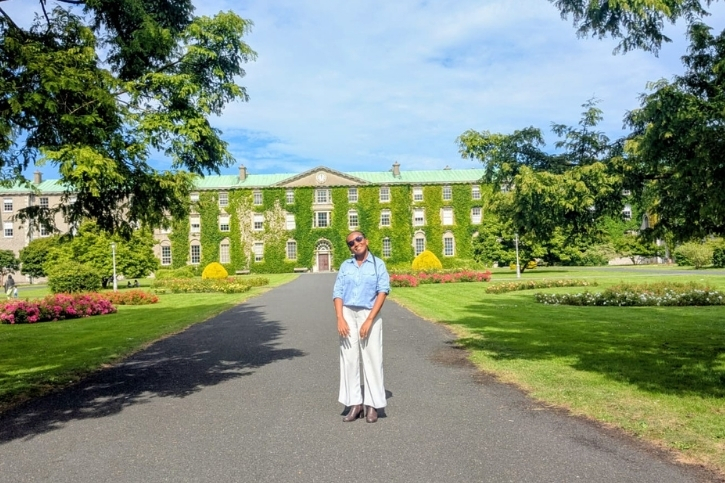
From Nairobi to Maynooth: Finding Connection 8,000 Kilometres from Home
by Eunice Murathe
As part of Maynooth University’s partnership with Aga Khan University, MA Strategic Communication student Eunice Murathe completed an internship with the Arqus European University Alliance Team through AKU’s Reciprocal Virtual Internship Programme (RVIP), before visiting Maynooth University for the 6th Arqus Annual Conference in July 2026.
Here, Eunice reflects on the people she met, the perspectives that challenged and inspired her, and what her experience taught her about inclusion, belonging and the value of international exchange.
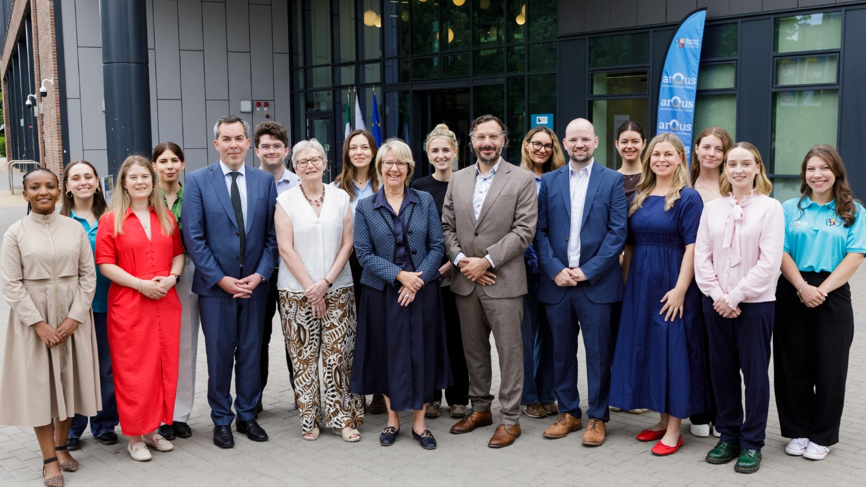
Every Ireland travel story I have read so far leads with the weather. I didn’t check the weather forecast before my trip. The weeks preceding it had been spent in hospital corridors, ICU, HDU, the smell of hand sanitiser, doctors speaking carefully and test results for a loved one arriving like verdicts. There was no room in my head for the sensible admin of a person about to leave the country. So, on the Friday night, just hours before my flight, I took whichever clothes I could find close by and threw them into a suitcase. A cardigan here. Two t-shirts that had nothing in common with each other. Sandals. Whatever was within reach.
Thankfully, Nairobi and Ireland had quietly agreed to swap weather for the week. Nairobi auditioned for Dublin. Ireland remembered that a full day of sunshine exists. It became the running joke from day one, that I had somehow smuggled Nairobi sunshine through customs. “If you are all nice to me,” I”d say, “I might leave it behind.” The Irish, being Irish, smiled politely. Poor thing, they were probably thinking. She has no idea what our weather is capable of, four seasons in an hour.
The real warmth, though, was in the people. I had gone to Maynooth University through a partnership with the Aga Khan University Global Engagement office, expecting exactly what people expect from such a visit: lectures, campus tours, polite conversations, group photographs where everyone leans in and pulls out a plastic smile, and perhaps a tote bag if I was lucky. Instead, Maynooth behaved like that friend who invites you for coffee and, before you have finished your first cup, asks what you really think about migration, belonging, identity, power, African literature, storytelling, even robotic farming and whether you have considered a PhD after your masters
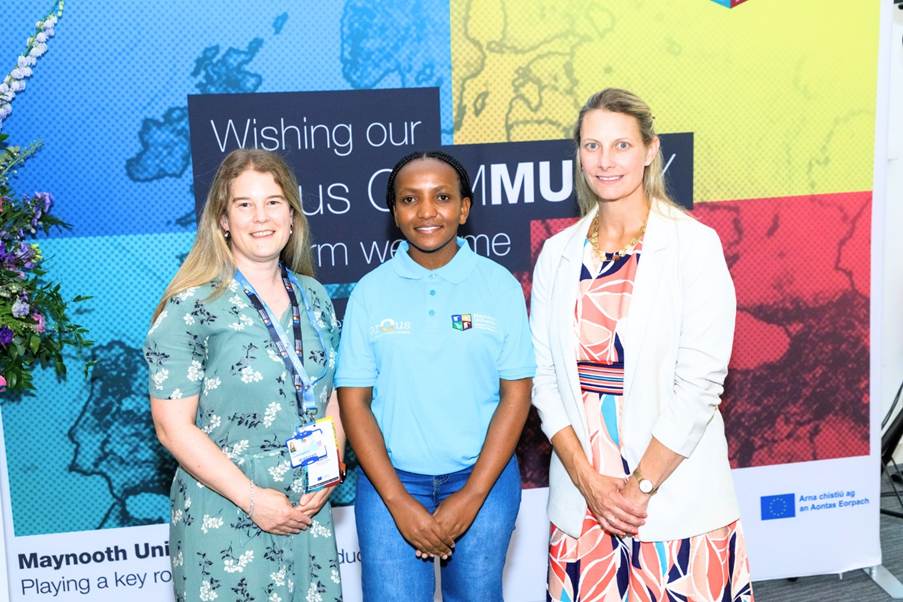
From left: Philippa Harper, Arqus Alliance Engagement Coordinator; Eunice Murathe, MASC student at The Aga Khan University Graduate School of Media and Communications; and Rebecca Doolin, Vice-President for External Affairs at Maynooth University, during the 6th Arqus Annual Conference
6th Arqus Annual Conference
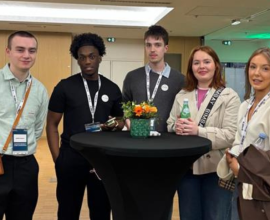
The week I landed happened to be the opening of the 6th Arqus Annual Conference, running under the theme “Voices of Impact.” Students, lecturers, researchers from nine universities across Europe gathered around one question: what does a sustainable Europe, held together by strong university alliances, look like. It was amazing to witness and participate in the swapping of ideas, inspiring each other, shaping the future of higher education somewhere between the coffee breaks and the panel discussions.
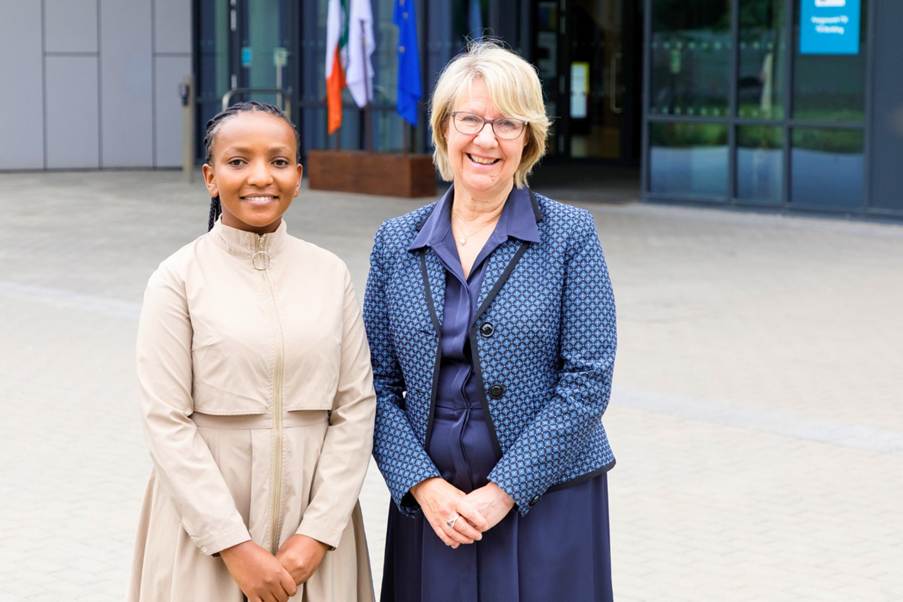
Eunice Murathe with Professor Eeva Leinonen, President of Maynooth University, during her visit to the university as part of the 6th Arqus Annual Conference.
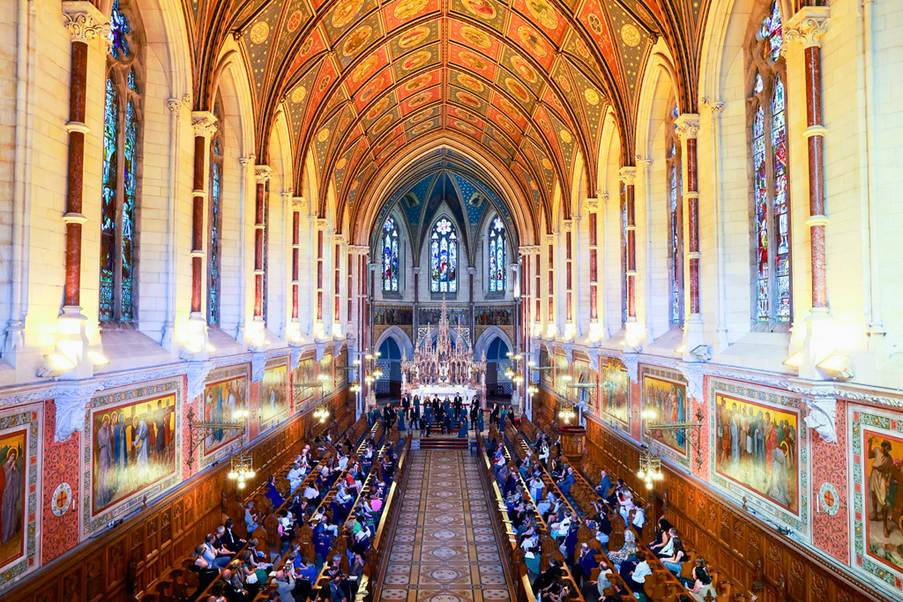
The finale of that first day had nothing to do with policy or panels. It was Vivaldi’s Gloria, sung by the joint choirs of six Arqus universities, joined by Maynooth’s own Chamber Choir, inside the College Chapel of St Patrick’s College. I found myself captivated not only by the music but also by the beauty of the space itself. I have a deep reverence for historic buildings because they embody extraordinary craftsmanship, patience, and devotion. Every arch, every carving, every detail feels intentional, as though nothing was added carelessly, and nothing was left to chance. They were built as complete works of art, designed not merely to serve a function but to inspire awe. Standing there, I wondered whether our obsession with minimalism has sometimes made us forget that buildings can be more than functional.
Inclusion is not achieved by declaring people welcome
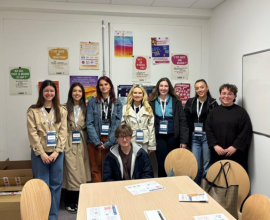
During the conference I also found myself in one of the working groups sessions led by Martha Brandes, Head of Access Operations at the Maynooth University Access Programme (MAP). Our group explored what inclusion should truly look like in short-term mobility programmes. One case study stayed with me. We were introduced to Andra, a student, a mother, and an immigrant to Ireland with a young child and no family nearby. She had been invited to participate in a mobility programme in Portugal. The question before us was simple, yet profound: So, what would inclusion look like for her? Not a policy line about “flexibility” and a sentence in a brochure saying everyone is welcome. The specific, sometimes unglamorous architecture underneath it. Where would her child stay? Who would care for the child while she participated? What would happen if the programme schedule conflicted with her responsibilities as a mother?
And sitting in that room, I kept returning to a quieter thought: that there is a kind of exclusion more insidious than a locked door. This kind does not stop you at the gate. It lets you in, only for you to discover that nothing on the other side was built with you in mind. You are not refused. You are simply left to solve, alone and invisibly, the parts of your life the system never bothered to picture. We often like to speak of inclusion in the language of feeling. We use words like welcomed, seen and valued. I left that session believing that it should be practical and logistical before it can become emotional. For Andra, for instance, inclusion is childcare and housing. You cannot feel welcome in a place that hasn’t yet figured out where your child will sleep.
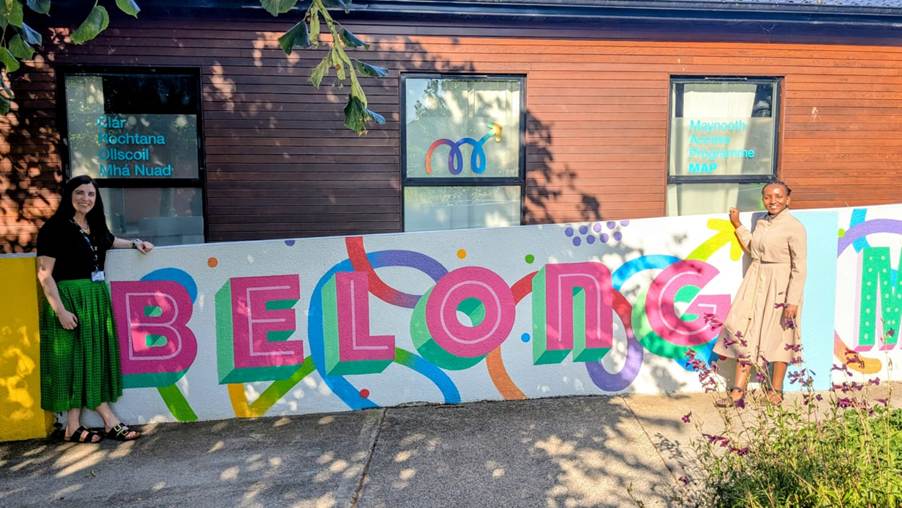
Eunice Murathe with Martha Brandes, Head of Access Operations at the Maynooth University Access Programme (MAP)
This practical lens on inclusion was one of the many threads Martha Brandes and I picked up again later in her office. We spoke about how it is not enough to have the right words in a policy document or on a slide deck. The real questions are less glamorous and far more demanding: What is happening on the ground? What practical steps are being taken? And are they robust enough to withstand the realities of someone’s everyday life? Too often, people are expected to become lighter, less encumbered, or reshape themselves to fit a room that had already, on paper, declared them welcome.
Our conversation soon moved beyond universities. We spoke about the broader challenge of inclusion in Irish society, and that was when I first properly learned about the Irish Traveller community. The community was formally recognised by the state as a distinct ethnic group only in 2017. And yet recognition on paper has not closed the distance between how the community is lived with. Many Travellers continue to experience inequalities in housing, healthcare, education and employment. It made me think about home. Many countries, including my own, Kenya, carries communities whose experiences expose the gap between what systems promise and what people encounter. Some are recognised in law, unresolved in practice, their stories sitting quietly in the corner, waiting for someone to ask better questions and build better systems. I see versions of this too in workplace policies, immigration systems and the everyday social structures that can officially declare that you belong while remaining arranged in ways that make belonging difficult. Perhaps that is one of the hardest things about inclusion. We need to stop asking whether people are technically allowed into the room and start asking whether the room works for them once they arrive.
The reading list problem
Universities also have this annoying habit of making your reading list grow faster than your free time. I found my next assignment waiting for me at an art and book exhibition, Issue 8 of Cambridge Studies in African and Caribbean Literature, held by Cathy Coughlan, a Kenyan who had somehow made a corner in the Maynooth University library feel like home. I am a devoted consumer of books and art exhibitions, and perhaps because I have spent so much time around Kenyan contemporary art, some of the visual language has become so familiar to my eye that I sometimes forget how distinct it is when seen elsewhere. There was something unexpectedly moving, then, about encountering African literature and artistic expression in a university library so far from Nairobi. Writers such as Ngũgĩ wa Thiong’o were being introduced to a room that had not necessarily come looking for them but seemed to leave a little richer for having found them. More than 8,000 kilometres separates Nairobi from Maynooth, but as I sat among those event attendees, the distance felt much smaller.
Phillipa Harper, the Arqus Alliance Engagement Coordinator who had received me at the very start of the week and then, quietly, generously, spent nearly all of it with me, gave me a book by Dr Katriona O’Sullivan called Poor. She also drove me out to Trim Castle, the largest Anglo-Norman fortification in Ireland, built by Hugh de Lacy and his successors over three patient decades. Somewhere between the ancient stone walls, ice cream cones and a deeply personal story of human resilience, we agreed that grief, uncertainty and courage to begin again are universal. Sometimes, sharing them is how strangers become friends.
What I carried home
As someone who works in strategic communications to influence action, including policies, I spend a lot of time thinking about stories. Stories hiding behind policy papers, migration statistics and institutional language, all waiting to be noticed and told well enough to move someone to act.
Perhaps that is why this visit will stay with me. I hadn’t simply visited a university. I had found conversations that stretched me. People who encouraged curiosity instead of apologising for it. Stories that challenged what I thought I knew. Books that added to a reading list that was already too long. A historic chapel that made me look up. A castle that reminded me how long human beings have been building things that outlive them.
And made friends who made Ireland feel remarkably close to Nairobi. I had arrived in Ireland barely able to think beyond the next hospital update. I had packed a suitcase in a hurry because, at the time, my mind was elsewhere. But somewhere between the sunshine, the choir, the conversations about inclusion, the books and the long walks, something shifted. I started seeing possibilities and the resilience of human beings. I now have newer and better questions that I had not packed. I am more curious about belonging, the stories we choose to tell, the systems we build for people whose lives don’t fit neatly into them, and, perhaps most unexpectedly, about my own next chapter. Somewhere along the way, a dangerous little thought quietly settled into my mind: perhaps, just perhaps, a PhD isn’t such a ridiculous idea after all.
About the writer
Eunice Murathe is an award-winning journalist and communications professional with 10 years of experience spanning local and international newsrooms and the non-profit sector. She is currently a Communications Manager at CABI, where she connects science and impact with global audiences through strategic storytelling and media engagement. Eunice is pursuing a Master of Arts in Strategic Communication at The Aga Khan University Graduate School of Media and Communications.